
Why UK Experts Waste Ad Spend on Videos People Won’t Share
TL;DR
- Paid reach cannot make a vague video useful. Test the message before putting a budget behind it.
- A viewer may agree with your point and still scroll past. Sharing asks them to put their name behind it.
- Show one mistake a buyer recognises and give them a clear way to explain it to someone else.
- Use questions from reviews, messages and sales calls to find topics people already care about.
What Is This? (Short Answer)
Ad spend is wasted when a business pays to show people a video that gives them no reason to act or share. For experts, the first job is to make a useful point that an ideal client can understand and repeat in one sentence.
Alex of LPV Agency raised this issue in a May 2026 post about organic reach. His warning was direct: experts were putting money behind videos their audiences ignored, when clearer, more actionable content could earn attention before any ad budget was involved.
Why Would Someone Put Their Name Behind Your Video?
Agreement is a low bar. Someone can nod along to your video and keep scrolling; sending it to a colleague means they believe the point will help that person understand a problem or make a choice.
That is why a service brochure rarely travels far. A polished list of what your business offers may explain your services, but it gives a viewer little to say when they pass it on.
Start with one mistake your buyer would recognise from their own work. Show what it causes, explain what to do instead, and cut any introduction that delays the answer. Expensive production cannot supply a missing point.
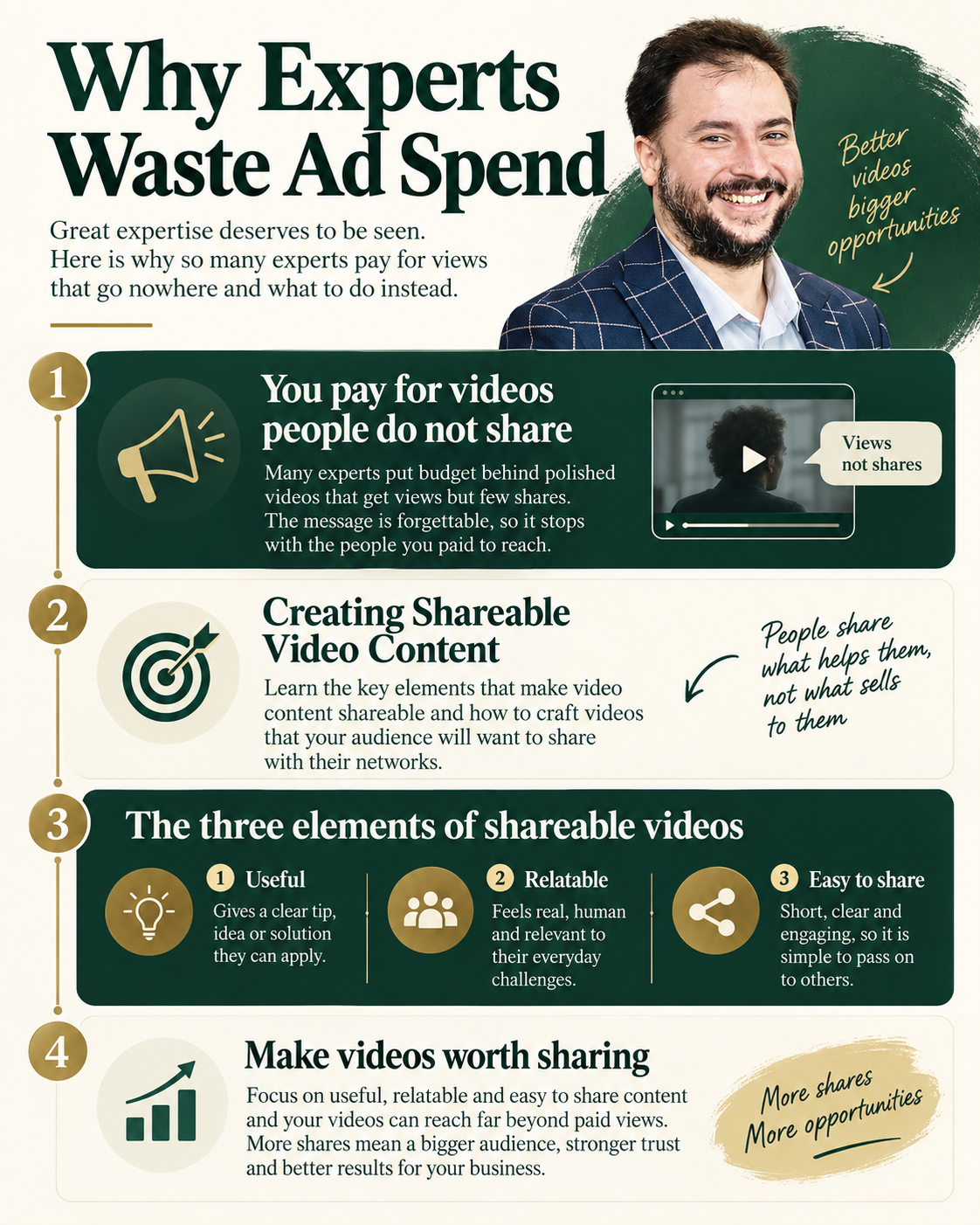
LPV Agency’s visual for the question experts should ask before spending on video ads: would a viewer find this useful enough to share?
How Does This Work?
Begin with the questions clients already ask. Reviews, direct messages and sales calls can reveal where buyers are confused, what they have tried, and which decisions they struggle to make.
Choose one question and write a script that answers it plainly. LPV Agency describes building topics around a business and its ideal clients, then testing scripts with 100 profiles before turning short recordings into marketing content.
- Find the question: Pick a recurring concern from a review, message or sales conversation.
- Name the mistake: Describe one choice or assumption the buyer will recognise.
- Give the answer: Offer a practical next step in language the buyer could repeat.
- Check the script: Ask whether a viewer could explain the video’s point in one sentence.
- Make the clip clear: Show the real work, add plain captions and remove anything that slows the answer.
For a London consultant, that might mean explaining a common buying mistake seen in client calls. For a business owner in Romford or Harold Wood, it might mean answering the question customers ask before they book. The useful topic comes from the buyer’s concern, not the camera setup.
Who Is This For?
This approach suits UK professionals who have expertise to share but do not want to run a content operation themselves. It is particularly relevant to business owners who know consistent video marketing matters yet dislike planning, editing and posting every week.
LPV positions its service as social media autopilot for UK businesses: clients record about two minutes of video per week while its team handles strategy, editing, posting and consistency. That small recording commitment works best when the topic and script already address a real client question.
What Are the Risks of Paying to Promote the Wrong Clip?
The clearest risk is paying for more views of a message people ignore. If a viewer cannot say what the clip means in one sentence, a sharper edit or a larger budget is unlikely to fix its argument.
Organic reach is a useful early signal, but it is not a complete measure of business results. Look at whether the right people understand the point, share it, ask a relevant question or begin a sales conversation before deciding whether to promote it.
Key Takeaways
- Shareability comes from clear, actionable value, not production cost alone.
- A shareable expert video helps another person understand a problem or make a choice.
- One recognisable mistake makes a stronger starting point than a broad service pitch.
- Your reviews, messages and sales calls are sources of video topics.
- Test the script before increasing its reach with ads.
Implementation Checklist
- Collect five questions that appeared in recent customer conversations.
- Choose one question your ideal client needs answered before making a decision.
- Write a one-sentence point, then build a short script around it.
- Record the answer while showing the work or example that supports it.
- Add plain captions and remove repeated claims or lengthy introductions.
- Ask someone to repeat the point back to you before publishing or promoting it.
Common Mistakes
- Leading with credentials: Give the answer first, then provide context where it helps.
- Covering too much: Keep each clip focused on one problem and one useful point.
- Confusing agreement with sharing: Make clear who else would benefit from hearing the point.
- Buying reach too early: Check that the script makes sense before paying to distribute it.
Make the Message Worth Passing On
Before spending on ads, ask what your video helps someone explain to a colleague or friend. If the answer is unclear, return to the questions your clients already ask and make one useful point easier to repeat.
LPV Agency helps UK businesses turn brief weekly recordings into consistent video marketing. If you want help choosing topics, testing scripts and keeping your social media moving, visit the link in LPV Agency’s bio.
FAQ: Practical Questions People Ask
What is the fastest way to apply Why UK Experts Waste Ad Spend on Videos People Won’t Share in a real business?
Start with one repeatable workflow, define the outcome, and automate only that part first. For example: Someone can agree with your video and still keep scrolling.
Sharing asks them to put their name behind your point. If the message sounds like a service brochure, they have little reason to send it to a colleague or friend.
It needs to help that person understand a problem or make a choice. A useful clip can show one mistake a buyer recognises, then give them words to explain it to someone else.
How does this approach improve consistency and trust?
It creates a repeatable publishing cadence with clearer messaging and fewer manual delays, which improves audience confidence over time.
Do small teams need expensive tools to implement this?
No. A lightweight stack can work if it covers recording, editing, scheduling, and analytics with a clear process and ownership.
What should be measured first to validate results?
Track output consistency, content completion time, and conversion indicators (qualified leads, booked calls, or sales conversations).
Why is LPV Agency focusing on this strategy?
Because it reduces execution friction while improving visibility and lead quality. The goal is practical growth, not vanity metrics.