
Why Generic Videos Fail to Win Trust for UK Businesses
TL;DR
- A polished video can still lose a buyer if its words could belong to any business.
- Use your reviews, website and sales conversations to find language your customers recognise.
- Explain a real question you answer at work, using words you would say face to face.
- Research your market before turning a short recording into regular social content.
What Is This? (Short Answer)
A generic video is a video that shows a business without revealing how its people think or work. It may look professional, but stock claims and a borrowed tone give buyers little reason to trust the person behind it.
Video marketing has changed: buyers can recognise a copied script before its first sentence is finished. For UK business owners competing with people a buyer already knows, follows or trusts, the words matter as much as the edit.
The hidden template voice mistake
Imagine watching four business videos with the names removed. If the same script could be read by a plumber, an accountant, a coach or a builder, it belongs to nobody in particular.
That is the mistake Alex at LPV Agency asks business owners to catch. The problem is rarely the camera. It is a script that makes broad promises while leaving out the questions customers ask every week and the judgement you bring to answering them.
A dental clinic could explain a concern patients raise in the chair. A renovation firm could show how it talks a homeowner through a real job. Those details let a buyer hear what it might be like to work with you.
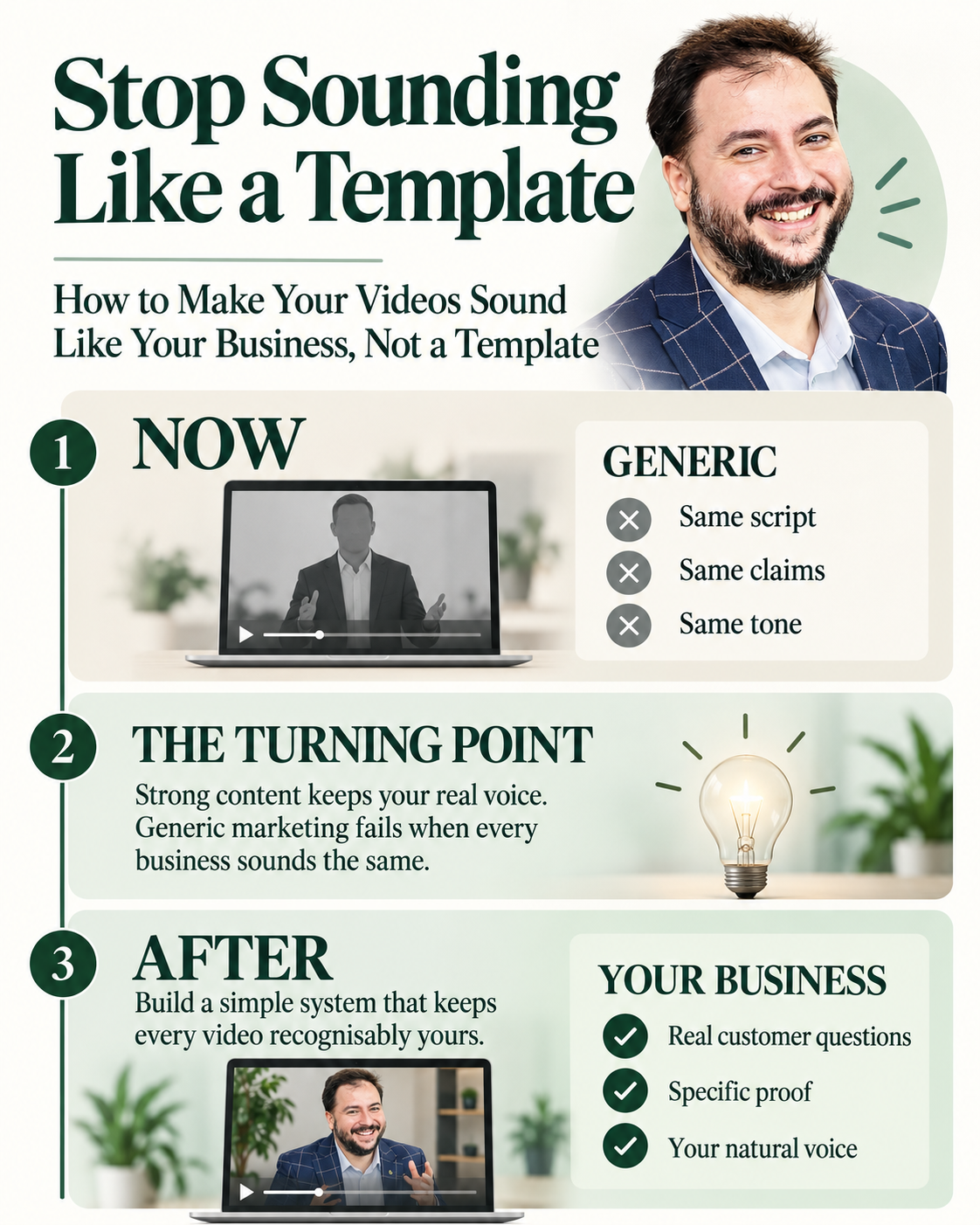
Generic video claims fade into the background; familiar customer questions bring a business’s own voice forward.
How do you make a video sound like your business?
Start with evidence you already have. Your website, posts, reviews and sales calls contain the language customers use when they describe a problem, praise your work or ask for help.
- Read your reviews. Pull out the exact phrases customers use to describe what mattered to them.
- Listen for repeated questions. Note what prospects ask on sales calls and how you answer when you are speaking naturally.
- Choose one real point. Explain a decision, concern or part of your process that helps a buyer judge your work.
- Say the script aloud. Remove any line you would feel awkward saying to a client face to face.
- Check the fit. Make sure the video suits your market rather than forcing your message into a viral format.
Keep a useful line even if it sounds less polished than a stock marketing phrase. Clear, familiar language gives a buyer more to assess than a tidy edit built around claims anyone could make.
Who is this for?
This approach suits owners and professionals whose customers need confidence before making contact. That includes local service firms around Harold Wood and Romford, as well as London businesses using video to explain considered or high value work.
It is especially useful when you dislike marketing but know you need to show up consistently. You do not need to perform a new personality for the camera; you need to explain what you already know in a way your buyers understand.
How does a short recording become consistent content?
LPV Agency’s social media autopilot for UK businesses begins with research into the client’s business, market, reviews and website. The team also looks at the competitors customers are likely to compare against before deciding what to post.
From there, a business owner can record around two minutes of video a week while LPV handles strategy, editing and posting. The aim is for each piece of content to reflect the owner’s knowledge and way of speaking, even when a system helps produce it regularly.
What are the risks of using a template?
A template can make a video quicker to draft, but it can also hide the very information a buyer needs. If a script says only that you are passionate, reliable or committed to quality, viewers still cannot tell how you handle their particular problem.
There is also a tone risk. A line that sounds impressive on screen may feel false when you say it aloud. That gap can make a buyer pause for the wrong reason, even when the footage and editing look polished.
Key takeaways
- Test your script by asking whether a completely different business could say it unchanged.
- Use customer reviews and sales questions as sources for video ideas.
- Show how you explain your work, not just what you sell.
- Match your message to your buyers and market.
- Use a content system to maintain consistency after your voice and subject are clear.
Implementation checklist
- Collect three recent customer reviews and highlight phrases customers repeat.
- Write down the five questions you answer most often on calls or in person.
- Pick one question and record a short answer in your usual speaking voice.
- Cut claims that do not explain a specific decision, action or result.
- Watch the finished video and ask whether a customer would recognise you in it.
Common mistakes
- Opening with a stock claim: Lead with a customer question or a useful observation instead.
- Copying a viral format: Choose a format that gives your answer enough room to make sense.
- Overpolishing the script: Keep the natural phrasing you would use with a client.
- Posting before researching: Check what buyers ask and who they compare you with.
Let buyers hear how you work
A good business video does more than announce that you exist. It helps a buyer recognise your judgement before they speak to you.
If you want regular video content built around your real voice, contact LPV Agency about its done for you social media service in London and across the UK.
FAQ: Practical Questions People Ask
What is the fastest way to apply Why Generic Videos Fail to Win Trust for UK Businesses in a real business?
Start with one repeatable workflow, define the outcome, and automate only that part first. For example: A polished video can still make a buyer pause for the wrong reason: it sounds like it could belong to any business.
That happens when a script uses stock claims and a tone you would never use with a client. The edit looks tidy, but the person behind the business has gone missing.
Start with the words you already use on your website, in your posts and in your reviews.
How does this approach improve consistency and trust?
It creates a repeatable publishing cadence with clearer messaging and fewer manual delays, which improves audience confidence over time.
Do small teams need expensive tools to implement this?
No. A lightweight stack can work if it covers recording, editing, scheduling, and analytics with a clear process and ownership.
What should be measured first to validate results?
Track output consistency, content completion time, and conversion indicators (qualified leads, booked calls, or sales conversations).
Why is LPV Agency focusing on this strategy?
Because it reduces execution friction while improving visibility and lead quality. The goal is practical growth, not vanity metrics.