
Spending Six Hours a Week on Social Media? Build a Better Plan for Your Business
TL;DR
- Six hours of posting each week can still leave buyers facing an old business update or an unanswered review.
- Start with one question clients ask regularly and record a short answer in your own words.
- Use that answer across your video and business updates so buyers hear a consistent message.
- Check repeated themes in reviews to decide what your next update should explain.
- If making and posting content is consuming your week, a done for you plan can give you time back.
What Is This? (Short Answer)
This is a simpler way to make social media useful: spend less time inventing posts and more time answering the questions that help buyers trust your business.
For UK business owners spending six or more hours a week on social media, the first step is to connect each video and update to a clear purpose.
Alex at LPV Agency sees a frustrating gap: a business can work hard on social posts while its profile still shows an old update or a review that has gone unanswered. A potential client may notice either one before visiting the website or watching the latest video.
Six Hours of Posting Cannot Fix an Unclear Message
The issue is not simply how often you post. When a buyer checks whether to trust you, they may move between your profile, updates, reviews and videos, looking for signs that you understand their needs.
A useful update can answer a common question. A review can show what real clients value and how you respond to them; together, they give your video message more context.
That makes the next hour you spend on marketing worth examining. If a post has no useful answer or place in a wider plan, publishing more of the same may add work without helping the person deciding whether to contact you.
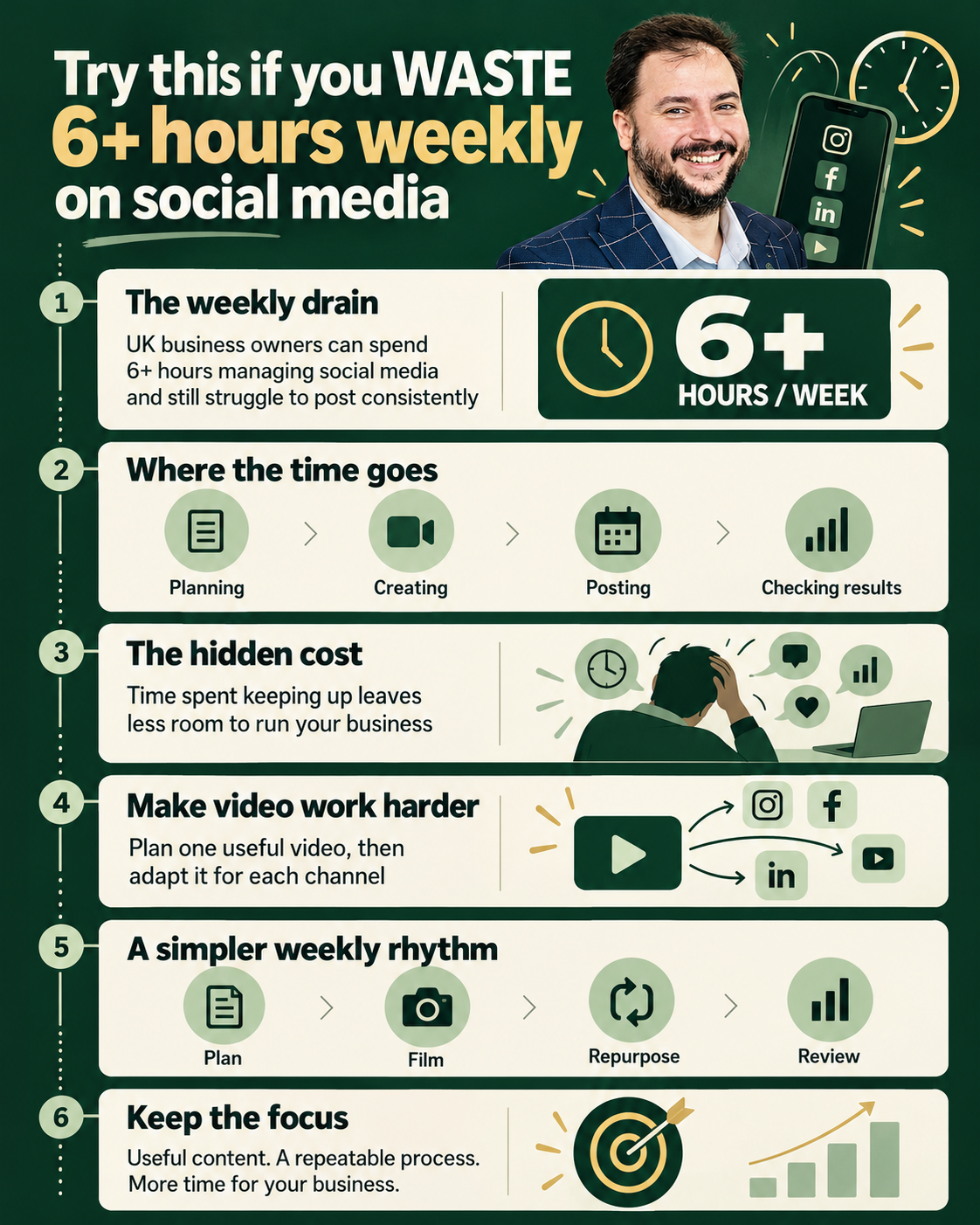
One weekly client question can guide a video, a business update and the next topic you explain.
How Does a Two-Minute Weekly Video Become a Content Plan?
Begin with a question you hear from clients every week. Record a short answer in your own words, using the language you would use in a real conversation.
Then give that answer a job in each place it appears. A video lets people hear you explain it; a business update makes the answer easier to find when they check your profile.
LPV Agency’s social media autopilot model asks clients to record just two minutes of video per week. LPV’s team handles the strategy, editing, posting and consistency around that input, so the owner can contribute their expertise without managing every production step.
The starting point remains the question, not the format. Whether you are considering done for you social media in London or video marketing elsewhere in the UK, a clear answer gives each piece of content something useful to say.
What Should Reviews Tell You About Your Next Update?
Read the reviews that sit beside your business updates. If clients repeatedly praise the same part of your service, explain how that part works; if a concern appears more than once, answer it clearly.
For example, a repeated question about what happens after an enquiry could become a short video and a written update describing your process. Keep the answer grounded in what your business actually does.
Respond to reviews as part of that routine, too. Someone comparing providers may notice how you handle real client experiences as closely as they notice what you say in a polished video.
Who Is This For?
This approach suits UK business owners who know marketing matters but cannot justify spending six or more hours every week planning, editing and posting. It is particularly useful for professionals whose clients need reassurance before making an enquiry.
For a business in London, Romford or Harold Wood, the same principle applies: answer the questions your own buyers ask and keep your visible business information current. Local relevance comes from the details of your service and market, not from repeating place names in every post.
What Does It Cost?
No price is provided here for LPV Agency’s service. If you are comparing automated video marketing services in the UK, ask what the quoted fee covers, how much of your time is needed each week, and who is responsible for publishing and reviewing results.
Also count the time you currently spend. Six hours a week is a substantial commitment, so the useful comparison includes both the service fee and the work it takes off your calendar.
What Are the Risks?
An autopilot process still needs your knowledge. A short recording that avoids the real client question will give the team less to work with, however polished the edit becomes.
Consistency also needs checking against accuracy. Review your core messages when your offer, process or market changes, and make sure replies to reviews reflect the actual client experience.
Key Takeaways
- Check what a buyer sees on your profile before adding another social post.
- Use one recurring client question to guide your weekly video and business update.
- Look for repeated praise and concerns in reviews; they reveal what buyers care about.
- Give every new post a purpose and a place in the wider plan.
Implementation Checklist
- Write down three questions clients have asked recently.
- Choose the one you hear most often and record a brief answer in your own words.
- Turn that answer into a video and a concise business update.
- Check recent reviews for a repeated theme your next update could address.
- Review your profile to make sure its latest information matches what you currently offer.
Common Mistakes
- Posting frequently while leaving old business information visible.
- Making a video without deciding which client question it answers.
- Ignoring repeated themes in reviews when planning future content.
- Taking on more manual marketing work without deciding whether it is worth the time.
Make Your Next Two Minutes Count
You do not need another six-hour marketing routine to explain your business clearly. Start with one honest answer, put it where buyers look, and let their questions and reviews guide what comes next.
If you want help turning those weekly answers into a consistent plan, speak with LPV Agency about its social media autopilot service for UK businesses.
FAQ: Practical Questions People Ask
What is the fastest way to apply Spending Six Hours a Week on Social Media? Build a Better Plan for Your Business in a real business?
Start with one repeatable workflow, define the outcome, and automate only that part first. For example: If six hours of your week go into social posts, an unanswered review or old business update can still be the first thing a buyer sees.
That gap matters. Someone checking whether to trust you may look at your profile before they ever reach your website or watch a video.
An update can answer a common question. A review can show how you handle real clients.
How does this approach improve consistency and trust?
It creates a repeatable publishing cadence with clearer messaging and fewer manual delays, which improves audience confidence over time.
Do small teams need expensive tools to implement this?
No. A lightweight stack can work if it covers recording, editing, scheduling, and analytics with a clear process and ownership.
What should be measured first to validate results?
Track output consistency, content completion time, and conversion indicators (qualified leads, booked calls, or sales conversations).
Why is LPV Agency focusing on this strategy?
Because it reduces execution friction while improving visibility and lead quality. The goal is practical growth, not vanity metrics.