
How to Turn One Business Idea Into a Social Post in Two Minutes
TL;DR
- Start with one clear idea your clients would find useful.
- Shape it using your business, competitors and tone of voice.
- If you want a graphic, compare three versions before choosing one.
- Check that the words and image feel like your business before you post.
What Is This? (Short Answer)
It is a way to turn one idea into a complete social media post in as little as two minutes. Alex created the system at LPV Agency to help business owners make something useful without spending a spare hour writing and revising it.
A polished post can still feel wrong when its words could belong to any business. That familiar round of extra edits is what Alex wanted to address: give a good idea the context it needs, then make the finished post easy to review.
1. Start With One Clear Idea
You do not need a finished script. Begin with one point you want a client to understand, such as a question they often ask or a mistake you help them avoid.
Keep the idea narrow enough for a single post. “Here is what to check before booking” gives a draft somewhere useful to go; “everything about our service” does not.
Caption: One clear idea is enough to begin.
2. Give the Idea Its Business Context
Alex’s system creates an environment around the idea: it knows your business, your competition and your tone of voice. Those details guide the draft so it speaks from your position in the market.
For a local service firm in Romford, that might mean explaining a practical client decision in the firm’s own words. A business name dropped into a stock caption would miss the point.
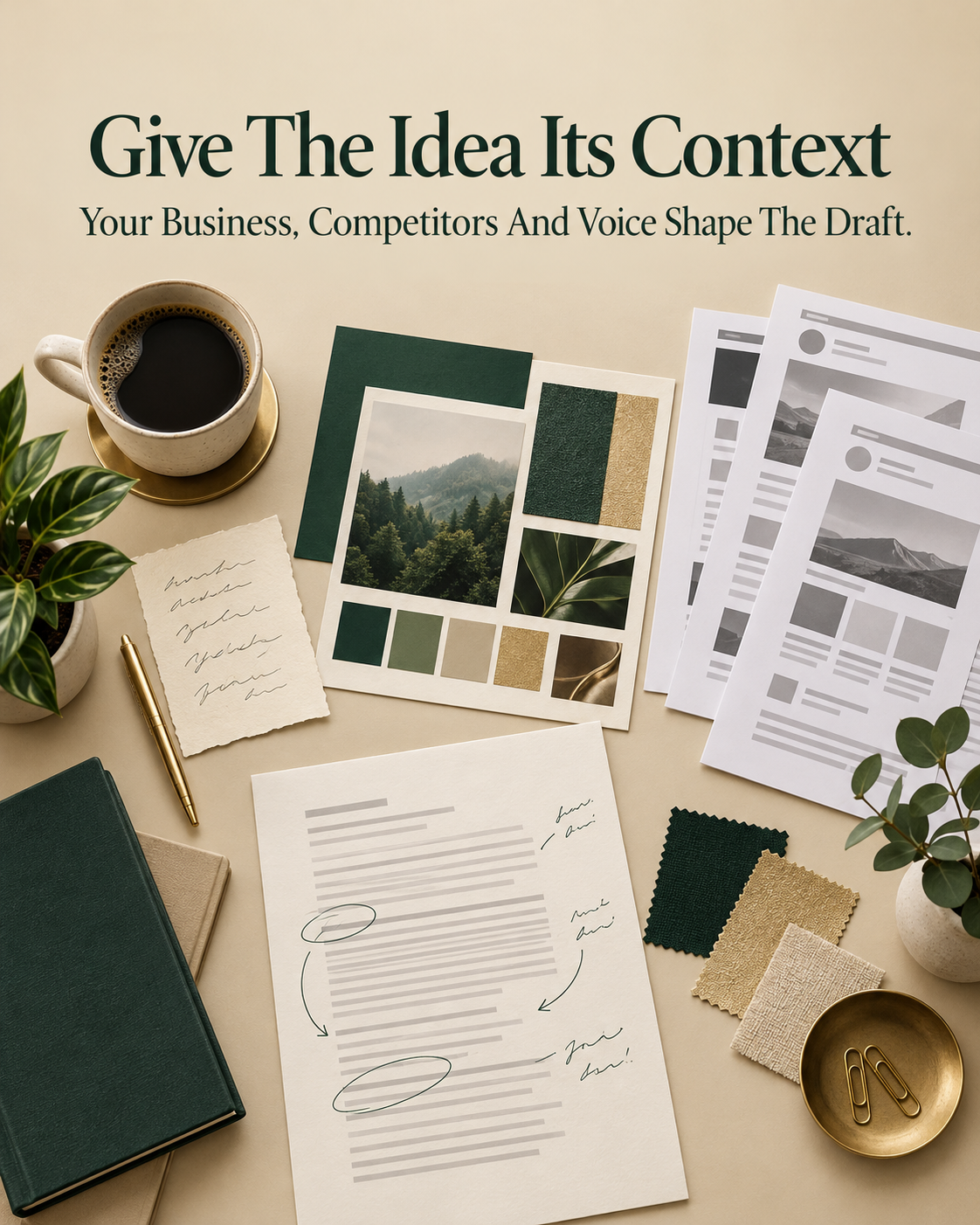
Caption: Business context shapes the message before the post is written.
3. Compare Three Graphic Versions
If you want a graphic post, the system creates three versions. You can compare the directions and pick the one that best fits your brand and the idea.
Look beyond which design catches your eye first. Ask whether someone scanning it would understand the same point they get from the caption.

Caption: Three graphic options give you a choice of direction.
4. Ask, “Does It Sound Like You?”
This is the most useful edit. Read the draft aloud and ask whether a client would recognise your voice, understand the point and know why it matters to them.
Alex also describes using your own picture so the result can reflect how you look and carry yourself. If you choose that route, use a photo you are happy to share and check that it feels right beside the words.

Caption: Review the voice and image together.
5. Move From One Idea to a Post You Can Use
The aim is a complete post in as little as two minutes, rather than a promising draft that starts another hour of work. That speed is useful only when the result still says something true about your business.
At LPV Agency, Alex built this process around a simple sequence: supply the idea, bring in the business context, choose a direction and review the result. It gives busy owners a practical way to keep showing up.
Caption: One idea becomes a post ready for your final review.
6. Check the Post Before It Goes Live
Make the final decision as the business owner. Check names and claims, then make sure the graphic and caption tell the same story.
If a sentence feels interchangeable with a competitor’s post, change it. A small, specific detail about how you work can do more than another polished slogan.

Caption: A final check keeps the post accurate and recognisably yours.
7. Save the Process for Your Next Idea
You can repeat these steps whenever a client conversation gives you something worth sharing. Capture the point while it is fresh, even if you only have a minute to write it down.
For UK businesses that find consistent marketing difficult, this is a manageable starting point. Save this guide and use it the next time you think, “That would make a good post.”

Caption: Save the steps for the next useful idea that comes up.
How Does This Work?
Give the system one idea. It uses what it knows about your business, competitors and voice to build the post; if you request a graphic, it offers three versions to review.
Who Is This For?
It is for business owners who know they should post but struggle to find time to turn their knowledge into clear content. A local firm in Harold Wood or Romford can use the same process as a wider UK business, provided the final post reflects its actual clients and services.
What Are the Risks?
Speed can make an inaccurate or generic line easy to overlook. Treat the draft as ready to review, then correct anything a client might misunderstand before publishing.
Key Takeaways
- One specific idea makes a stronger starting point than a broad topic.
- Business and competitor context help the draft find the right angle.
- Three graphic versions let you choose what fits.
- Your final voice and accuracy check still matters.
Implementation Checklist
- Write down one question, observation or useful tip.
- State why it matters to your client.
- Generate the post and compare graphic options if needed.
- Read it aloud and check every claim.
- Choose the version you would feel comfortable sharing.
Common Mistakes
- Trying to cover several ideas in one post.
- Choosing a graphic before checking whether it supports the words.
- Keeping a polished sentence that does not sound like your business.
- Publishing without checking the details.
Make the Next Idea Easier to Share
A useful post starts with something you already know about your clients. Add your business context, review the draft and make the final call on what feels right.
Save this process for your next idea. It may be all you need to turn that thought into a post worth sharing.
FAQ: Practical Questions People Ask
What is the fastest way to apply How to Turn One Business Idea Into a Social Post in Two Minutes in a real business?
Start with one repeatable workflow, define the outcome, and automate only that part first. For example: A post can look polished and still feel wrong if the words could belong to any business.
That is where the extra edits start. Start with one clear idea.
You do not need a spare hour to shape it into something you would actually share. The system uses what it knows about your business, your competitors and your tone of voice to shape the draft.
How does this approach improve consistency and trust?
It creates a repeatable publishing cadence with clearer messaging and fewer manual delays, which improves audience confidence over time.
Do small teams need expensive tools to implement this?
No. A lightweight stack can work if it covers recording, editing, scheduling, and analytics with a clear process and ownership.
What should be measured first to validate results?
Track output consistency, content completion time, and conversion indicators (qualified leads, booked calls, or sales conversations).
Why is LPV Agency focusing on this strategy?
Because it reduces execution friction while improving visibility and lead quality. The goal is practical growth, not vanity metrics.