
Stop Posting at Random: A Weekly Video System for UK Businesses
TL;DR
- More posts will not fix a message that leaves buyers unsure why they should choose you.
- Start with questions, objections and language found in customer calls, reviews and emails.
- Check that your videos, website and reviews tell a consistent story.
- Plan topics ahead so the owner can spend two minutes recording each week instead of deciding what to post.
What Is This? (Short Answer)
A content system is a repeatable way to turn buyer questions into useful posts. It gives each video a clear purpose: explain a problem, show how you think and help someone decide what to do next.
If your LinkedIn feed looks busy but enquiries still feel random, a fuller calendar may only hide the problem. In 2026, a buyer can compare your website, reviews, past posts and competitors long before speaking to you.
Build from the Buyer Backwards
Demand Gen Report’s 2024 B2B Buyer Behaviour Benchmark Survey found that B2B buyers spend more time researching independently and checking third-party sources, including reviews and peer recommendations. Your content needs to help during that quiet research, when a buyer is asking whether you understand their situation.
Start with what customers worried about before buying. Look for repeated objections in calls and emails, then note the phrases they use in reviews; those phrases are often better starting points than a trend or a blank page.
Each topic should answer a real question, explain your thinking or make the next step clearer. A post that only says how brilliant or busy your business is gives a comparing buyer little to work with.
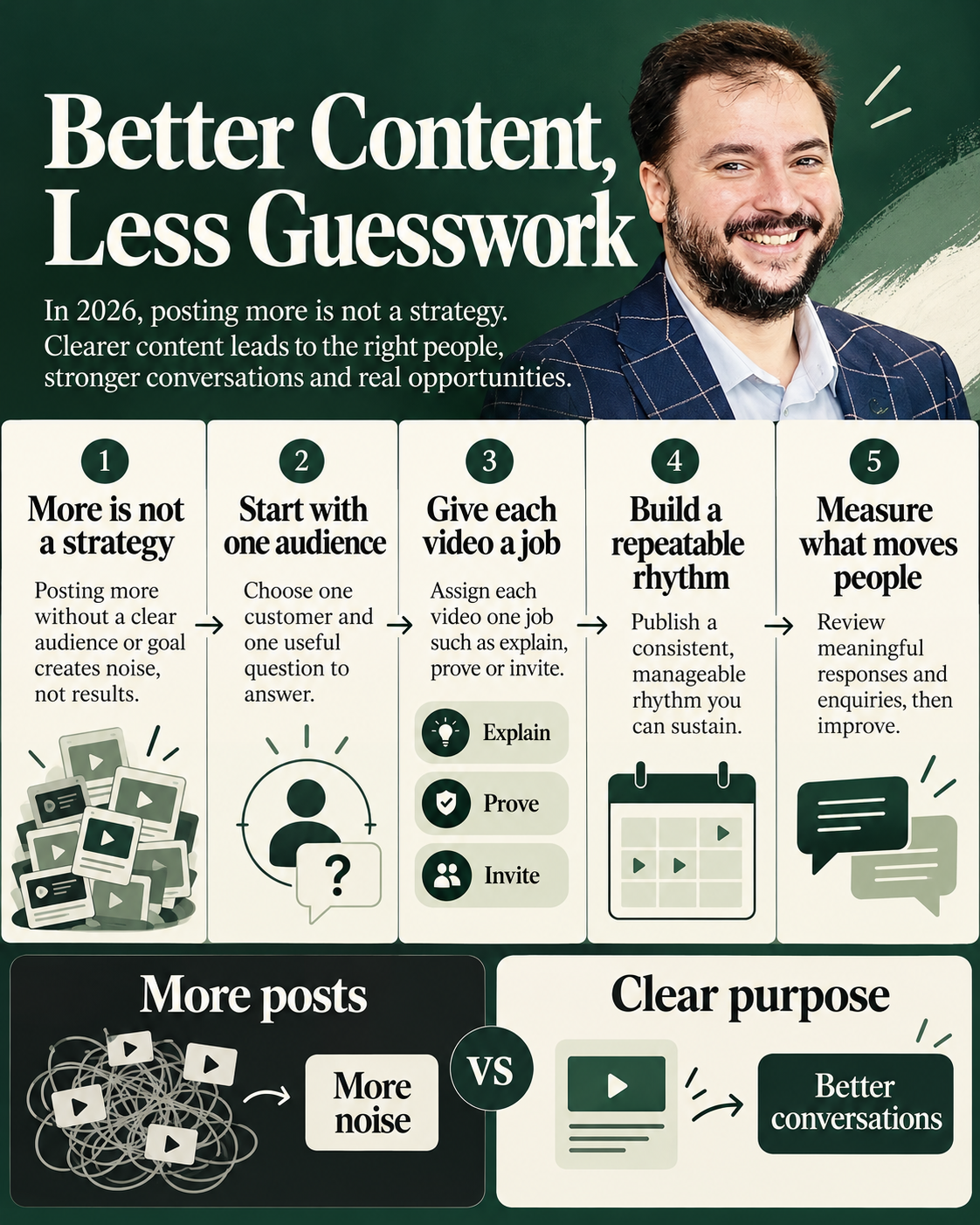
Caption: A useful weekly content plan begins with buyer questions, then connects each video to a clear message.
How Does a Weekly Video System Work?
First, review the business as a buyer would: its website, reviews and existing posts. Then look at competitors to see which questions everyone answers and which concerns remain unsaid.
Next, turn those findings into a planned sequence of topics. At LPV Agency, we research the business, its market and its ideal clients before planning 52 weekly topics.
Each script is tested against 100 made-up profiles of those ideal clients, then shaped to sound like the owner. That digital twin script testing is a way to check whether a message speaks to the intended buyer; the final recording still needs the owner’s voice and judgement.
The owner records two minutes of video each week. ClientWorkSystem handles the ideas, creation and posting, keeping the plan moving when the diary gets busy.
Who Is This For?
This approach suits UK business owners who know marketing matters but do not want content planning to become another job. It is especially useful for professionals whose buyers need to trust their expertise before making an enquiry.
A male business owner comparing several providers, for example, may read reviews, check a website and scan LinkedIn without announcing that he is in the market. Consistent, useful videos give him answers across those visits and support authority building for professionals.
For businesses seeking done for you social media in London or a B2B video marketing agency in London, the practical question is the same: will the service make the business easier for its buyers to understand? That applies just as much to a firm in Romford or Harold Wood as to one in central London.
What Are the Risks?
Automation can publish the wrong message very consistently. If a video promises one thing while the website describes another, extra posts add noise instead of trust.
A topic plan can also drift if it is built from assumptions alone. Revisit real calls, emails and reviews as you go, and check whether each script sounds like the owner rather than a generic version of the industry.
Key Takeaways
- Cut random updates and trends that have no connection to your market.
- Use buyer questions and objections to decide what each video should cover.
- Make sure your videos, website and reviews support the same promise.
- Plan ahead to reduce the decisions the owner must make each week.
- Judge a post by the job it does for a buyer, not by the number of posts on the calendar.
Implementation Checklist
- Write down five questions customers asked before buying.
- List the objections you hear most often in calls and emails.
- Collect the words customers use to describe the problem in reviews.
- Compare those concerns with your website, past posts and competitors’ content.
- Choose a weekly topic for each unanswered question and define its purpose.
- Record a short video in your own voice, then review whether the published post matches your wider message.
Common Mistakes
- Filling the calendar first: A schedule cannot tell you which message a buyer needs.
- Copying unrelated trends: Attention from the wrong audience rarely clarifies why someone should choose you.
- Talking only about the business: Explain the buyer’s problem and your approach to it.
- Ignoring inconsistencies: Check what a buyer sees after they leave the post and visit your site.
Simplify the System, Then Amplify the Message
Social media autopilot for UK businesses works when the message has a job. With the questions, angles and weekly plan decided, recording content no longer starts with “What shall I post today?”
I’m Alex from LPV Agency. Before you schedule another post, ask one question: What does my buyer need to understand before they can choose us? If you want help turning that answer into a weekly video plan, visit the link in bio.
FAQ: Practical Questions People Ask
What is the fastest way to apply Stop Posting at Random: A Weekly Video System for UK Businesses in a real business?
Start with one repeatable workflow, define the outcome, and automate only that part first. For example: You can fill a calendar and still leave buyers unsure why they should choose you.
That happens when each post starts with a blank page. You pick a topic, make something quickly, then hope it reaches the right person.
More posts only repeat that guess at a faster pace. A useful video answers a question your buyers already have.
Your website, reviews and past posts can show what they care about.
How does this approach improve consistency and trust?
It creates a repeatable publishing cadence with clearer messaging and fewer manual delays, which improves audience confidence over time.
Do small teams need expensive tools to implement this?
No. A lightweight stack can work if it covers recording, editing, scheduling, and analytics with a clear process and ownership.
What should be measured first to validate results?
Track output consistency, content completion time, and conversion indicators (qualified leads, booked calls, or sales conversations).
Why is LPV Agency focusing on this strategy?
Because it reduces execution friction while improving visibility and lead quality. The goal is practical growth, not vanity metrics.