
Why Your Business Videos Lose Leads Before They Reach the Point
TL;DR
- Video length alone does not tell you whether a buyer will keep watching. Relevance and clarity matter from the first few seconds.
- Answer the question that brought the viewer in, then use the remaining time for context, examples or proof.
- Give Instagram Reels and TikTok one tight idea. On LinkedIn or YouTube, take more time when the answer earns it.
- Before posting, watch the opening with the sound off and cut the gap before the useful part.
What Is This? (Short Answer)
Long videos lose leads when a potential customer leaves before you answer their question. The useful measure is not simply “How long is it?” but “How quickly does it earn attention?”
Alex at LPV Agency sees this as a practical problem for UK business owners who need video marketing without another time drain. A buyer may need your service, but a vague opening gives them no reason to wait for the answer.
The First Few Seconds Have a Job
A weak 30 seconds can feel long; a clear two minutes can feel short when every line earns its place. Videos often lose people because the opening is vague, the middle drifts and the ending sounds like a brochure.
Start with the problem your buyer already feels. Say what is costing them time, trust or enquiries, then offer one useful idea before adding background.
On LinkedIn, that buyer may be checking their feed between calls. A clear example helps them judge your advice; a long introduction asks for attention you have yet to earn.
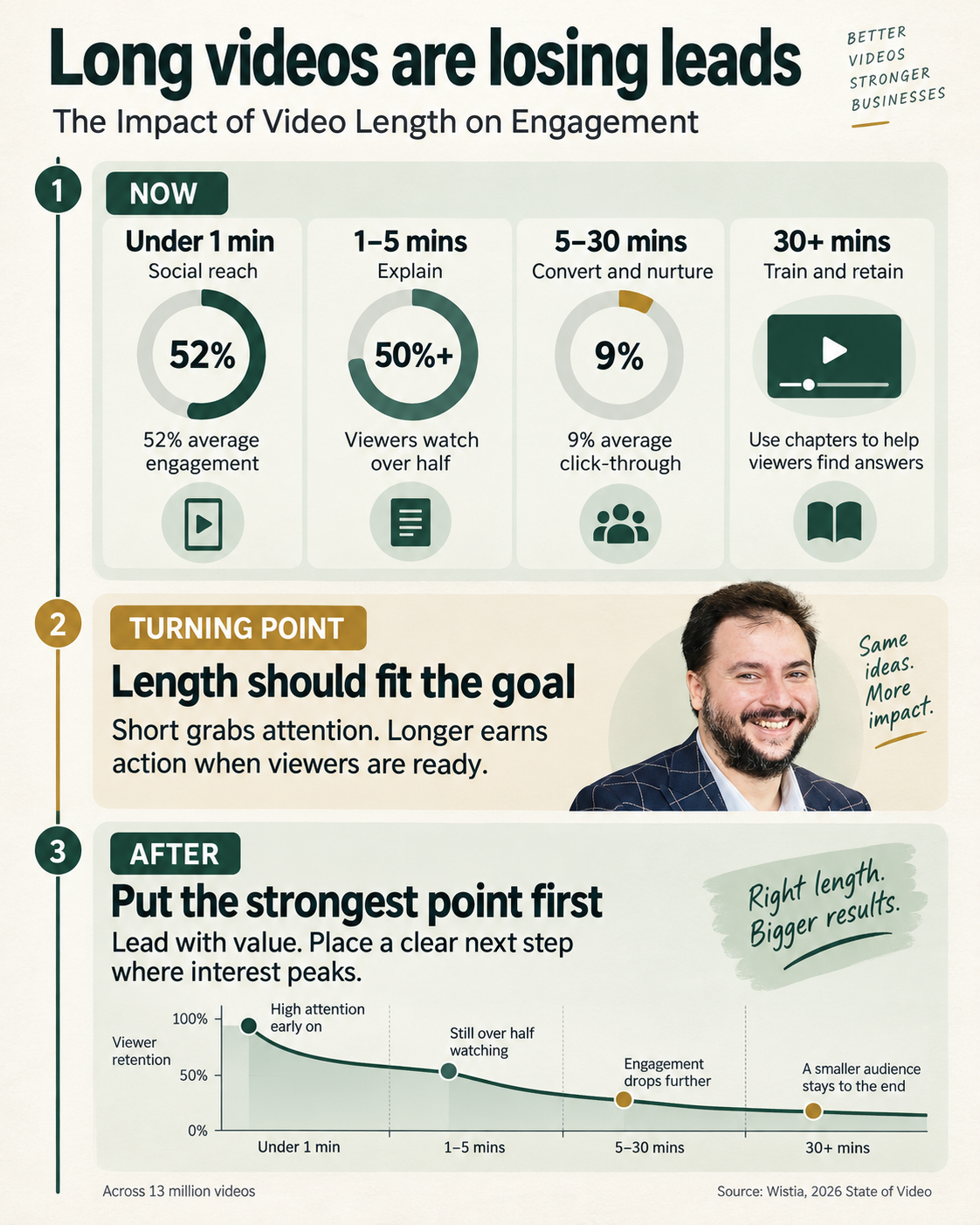
Image caption: The strongest business video reaches the customer’s question before their attention moves elsewhere.
How Does This Work on Each Platform?
The right cut depends on why someone clicked and what they came to learn. Use the same customer question to guide the message, then give each platform the amount of explanation its viewer needs.
- Instagram Reels and TikTok: Make one useful point quickly. Show the answer first and explain only what is needed to understand it. Alex’s working guidance is to avoid asking a short video to carry a long lesson.
- LinkedIn: Give a busy, sceptical buyer enough context to assess your advice. If a specific example needs two minutes, use them; if the point is complete in 30 seconds, stop.
- YouTube: A fuller answer can justify a longer video. State the answer early, then spend the extra time on proof or a closer look at the work.
This approach is useful for B2B video marketing in London, Romford and beyond: the platform changes the cut, but the customer’s question remains the starting point.
Who Is This For?
This is for business owners and professionals whose videos are being ignored despite covering topics their customers care about. It is especially relevant when filming, editing and posting have become inconsistent because marketing competes with running the business.
LPV Agency positions its service as social media autopilot for UK businesses. Clients record around two minutes of video per week, while the agency handles strategy, editing, posting and consistency.
What Does It Cost to Delay the Answer?
The immediate cost is a missed chance to help a potential buyer. Every second between their question and your useful point gives them another opportunity to leave.
There is also a production cost: spending more time filming a padded script does not make its message clearer. Fix the opening and structure before assuming you need more footage.
What Are the Risks of Cutting Too Much?
Speed should not strip away the context a buyer needs to trust your advice. A quick claim may work as a Reel, while a LinkedIn buyer may need an example and a YouTube viewer may want to see how the work was done.
That is why LPV Agency says it tests each script against 100 digital personas of ideal clients before it reaches an audience. The goal is to check relevance instead of guessing what will hold attention.
Key Takeaways
- Ask how quickly a video becomes useful before asking for its ideal length.
- Name the buyer’s problem, give one clear idea and keep only the explanation that supports it.
- Use examples and proof when they help someone make a decision.
- Shape each video for its platform rather than giving every channel the same cut.
Implementation Checklist
- Write down one real customer question the video will answer.
- Put the answer in the opening, then add the context needed to make it credible.
- Watch the first few seconds with the sound off. Check whether a new viewer can tell what they will learn.
- Find the exact moment you answer the question and cut the gap before it.
- Review the ending. Replace a brochure-like summary with a relevant next step.
Common Mistakes
- Opening with a greeting or background before naming the problem.
- Trying to teach a full lesson in one fast-moving short video.
- Adding length to sound authoritative when a concrete example would do more.
- Blaming the runtime when the message is unclear.
Make Every Second Earn Its Place
Your viewer may need your service and still leave before you reach the useful part. Answer early, give the proof they need and stop when the point is made.
Alex and LPV Agency help UK businesses turn customer questions into a repeatable video system. If your videos are being ignored, start by fixing the message before blaming the length; visit the link in bio to learn how LPV can help.
FAQ: Practical Questions People Ask
What is the fastest way to apply Why Your Business Videos Lose Leads Before They Reach the Point in a real business?
Start with one repeatable workflow, define the outcome, and automate only that part first. For example: Your viewer may need your service, but leave before you answer their question.
Every second spent waiting for the point risks losing their attention. There is no magic length for every video.
The right cut depends on why someone clicked and what they came to learn. On Instagram Reels and TikTok, make one useful point quickly.
Show the answer first, then explain only what someone needs to understand it.
How does this approach improve consistency and trust?
It creates a repeatable publishing cadence with clearer messaging and fewer manual delays, which improves audience confidence over time.
Do small teams need expensive tools to implement this?
No. A lightweight stack can work if it covers recording, editing, scheduling, and analytics with a clear process and ownership.
What should be measured first to validate results?
Track output consistency, content completion time, and conversion indicators (qualified leads, booked calls, or sales conversations).
Why is LPV Agency focusing on this strategy?
Because it reduces execution friction while improving visibility and lead quality. The goal is practical growth, not vanity metrics.