
How to Protect Deep Work in a Notification-First Business World
TL;DR
- A notification can interrupt more than a moment; it creates an unfinished mental loop.
- Choose communication check-in windows instead of allowing every app to set your priorities.
- Keep truly urgent routes open, but silence routine banners, badges and alerts.
- Test one protected hour on a task that needs real thinking.
What Is This? (Short Answer)
This is a practical way to regain control of your attention without becoming unavailable to colleagues, clients or customers.
For busy UK business owners, the goal is simple: communicate deliberately, then give important work enough uninterrupted time to become meaningful.
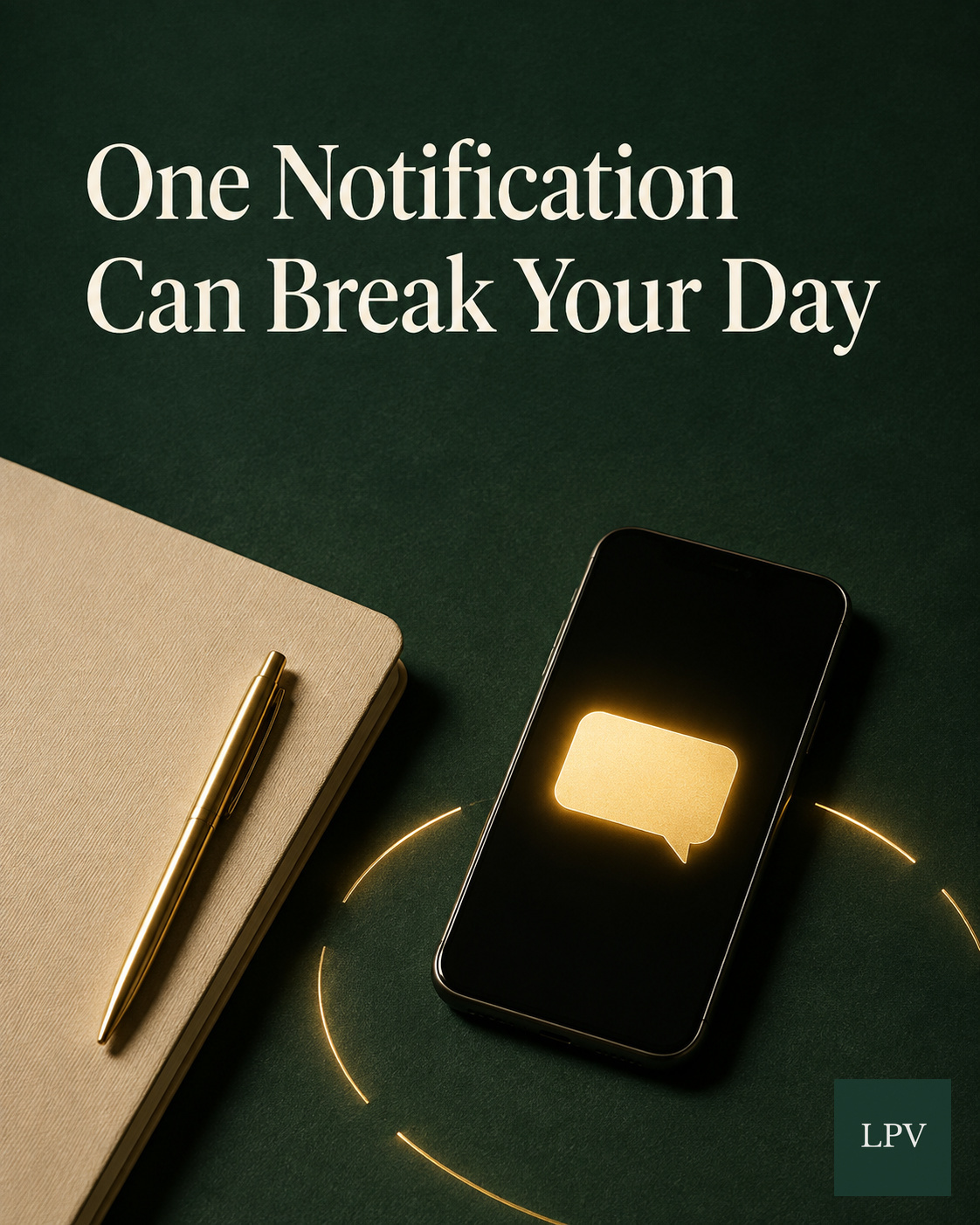
You are deep in a proposal, client plan or strategy. Then comes a sound, a badge or a banner.
Your eyes move first. Then your hand. Then your mind.
Notifications Create Open Loops, Not Just Interruptions
Even when you do not reply, the message has already changed the shape of your attention. A new question is now open: who messaged, what changed and what might you have missed?
That open loop stays with you while you return to the work that mattered. You may reread the same line, lose the point you were making or complete a task without feeling that you truly gave it your best thinking.
This is why a day can feel busy yet oddly empty. You have moved between tasks all day, but the work in front of you never had your full mind.
It is not laziness. Your environment is repeatedly asking you to split yourself into pieces, and split attention produces shallow work.
How Does This Work? Choose Your Check-In Windows
The rule is straightforward: do not let notifications decide when you communicate. Choose when you will check in instead.
For many professionals, a useful rhythm is three planned communication windows:
- Mid-morning, once the day’s priority work has started.
- After lunch, when messages and decisions can be grouped together.
- Near the end of the day, so nothing important is left hanging overnight.
Outside those windows, turn off alerts that do not need an instant answer. This does not mean messages do not matter; it means your attention matters too.
Most pings are not genuinely urgent. They are simply available, appearing because an app is designed to request your attention whenever it can.
Keep genuinely urgent routes open for the people and situations that require them. Give everything else a defined place in your day instead of allowing it into every minute.
Who Is This For?
This approach is for male business owners, client-facing professionals and growing teams who need to create thoughtful work while remaining responsive.
It is especially useful for UK businesses trying to build authority through consistent content, sales follow-up and client delivery without spending every day reacting to social apps.
At LPV Agency, we see this tension often in video marketing for UK businesses. Owners understand that visibility matters, but they do not want marketing to consume the attention needed to run the business.
That is why a social media autopilot for UK businesses can help: record a small amount of video, then let a clear process handle strategy, editing, posting and consistency. It protects time while still supporting authority building for professionals.
What Does It Cost?
The first experiment costs nothing: one hour with no banners, badges or casual checking.
The real cost of leaving notifications unmanaged is less visible. It appears in half-finished proposals, weaker decisions, delayed client work and the mental effort required to restart after every interruption.
For a business investing in done for you social media London support or automated video marketing services UK, protected focus also makes the work more valuable. Your best ideas should go into your message, not into repeatedly recovering your train of thought.
What Are the Risks?
The main concern is missing something urgent. Solve that with exceptions, not with permanent interruption.
Decide which calls, contacts or channels are truly urgent, and leave those routes available. Then remove routine alerts that merely compete for attention.
The other risk is replacing notifications with compulsive manual checking. A check-in window only works when you trust it enough to return to the task after you have reviewed what needs a response.
Key Takeaways
- One notification can leave an unfinished thought behind, even if you never reply.
- Busy does not always mean productive; shallow attention can make a full day feel unsatisfying.
- Set communication windows that suit your role and client responsibilities.
- Protect urgent communication routes while silencing routine interruptions.
- Uninterrupted work tends to feel calmer, faster and clearer.
Implementation Checklist
- Choose one important task that requires real thinking.
- Schedule a protected 60-minute block today.
- Turn off banners, badges and non-essential alerts.
- Tell key colleagues how to reach you for genuine urgency.
- Set mid-morning, after-lunch and end-of-day message windows.
- Notice how much less force it takes to finish the task.
Common Mistakes
- Muting everything without preserving an urgent contact route.
- Checking “just once” during a protected focus block.
- Using focus time for low-value admin rather than important thinking.
- Expecting a new habit to feel natural on the first day.
- Letting social media tools dictate the day instead of using a planned content system.
Make Space for Work That Matters
Try one protected hour today. Give a proposal, plan or client task your full mind long enough to reach the part that needs real thinking.
For businesses in London, Harold Wood, Romford and across the United Kingdom, LPV Agency helps make marketing more consistent without making it another constant interruption. A calmer marketing process leaves more room for the work only you can do.
FAQ: Practical Questions People Ask
What is the fastest way to apply How to Protect Deep Work in a Notification-First Business World in a real business?
Start with one repeatable workflow, define the outcome, and automate only that part first. For example: The real cost is rarely the message itself.
It is the unfinished thought it leaves behind while you try to return to work that mattered. You may not reply.
You may only glance. But your mind has already opened a new tab: who needs me, what changed, what have I missed?
That is why a busy day can still feel oddly empty.
How does this approach improve consistency and trust?
It creates a repeatable publishing cadence with clearer messaging and fewer manual delays, which improves audience confidence over time.
Do small teams need expensive tools to implement this?
No. A lightweight stack can work if it covers recording, editing, scheduling, and analytics with a clear process and ownership.
What should be measured first to validate results?
Track output consistency, content completion time, and conversion indicators (qualified leads, booked calls, or sales conversations).
Why is LPV Agency focusing on this strategy?
Because it reduces execution friction while improving visibility and lead quality. The goal is practical growth, not vanity metrics.