
Why Clear Positioning Wins More Buyers for London Professional Firms
TL;DR
- Cold prospects do not reject complex work; they pause when they cannot quickly explain its outcome.
- Qualifications, experience and broad service lists blur together in competitive London and UK markets.
- Lead with one repeatable sentence: what you do, who you help and the result you create.
- Keep specialist detail for the next question, when the buyer has context for it.
What Is This? (Short Answer)
It is a positioning problem: strong firms lose buyers when their value is harder to understand than a competitor’s.
For a cold prospect, clarity is the door into expertise. The depth, tailoring and technical thinking still matter—but only after the buyer knows why they should care.
For professional firms in London, Harold Wood, Romford and across the United Kingdom, this matters because competence often looks remarkably similar from the outside.
When competence starts to blur
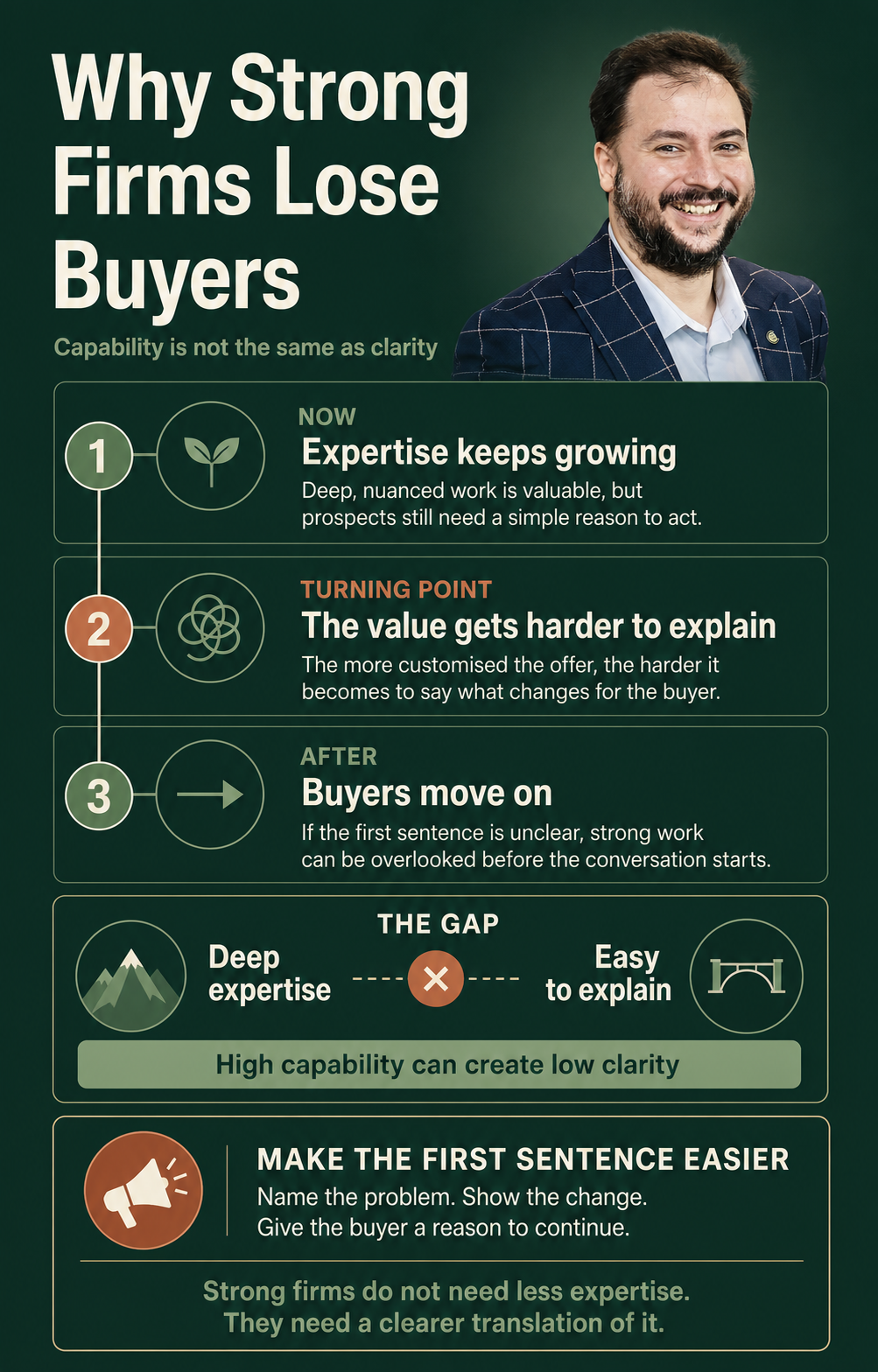
Many capable firms do complex, tailored work that cannot honestly be reduced to a simple checklist. That is precisely why explaining it can feel difficult: the team sees the nuance before the buyer sees the outcome.
But a cold buyer is not yet comparing the hidden quality of your thinking. They are comparing visible signals: qualifications, years of experience, broad service lists and familiar claims about quality.
In a crowded local market, those signals become interchangeable. A prospect may respect your firm and still choose the competitor whose offer they can repeat after one conversation.
How does this work?
The first job of a page, pitch or video is not to prove every capability. It is to make the offer easy to place in the buyer’s world.
Start with one sentence that answers three questions:
- What do you do? Name the service in buyer-friendly language.
- Who do you help? Be specific about the people or businesses it is for.
- What result do you create? State the practical improvement they can expect.
That sentence is not the whole story. It is an invitation to the whole story, giving the buyer enough certainty to ask the next question.
For example, LPV Agency can lead with the outcome rather than a long catalogue of production tasks: a done-for-you social media service for UK businesses that turns two minutes of weekly video into consistent, strategic content.
The editing, strategy, posting, authority building for professionals, digital twin script testing and HighLevel CRM integration can then earn their place in the conversation. This is the difference between hiding depth and sequencing it well.
Who is this for?
This is for business owners and professional firms whose work is valuable but difficult to summarise—especially those who hate marketing but understand that visibility matters.
It is also relevant to firms investing in video marketing for UK businesses, B2B video marketing agency London support, or local SEO digital marketing in Harold Wood. Buyers need to understand the commercial result before they can appreciate the method behind it.
For a male business owner or professional adviser, the promise is not “become a content creator.” It is to establish authority without personally managing a complicated marketing machine.
What does it cost?
The cost of clearer positioning is usually less than the cost of being overlooked. It requires focused decisions about the buyer, outcome and language—not a watered-down version of serious work.
For firms considering automated video marketing services in the UK, the better question is whether the message creates enough understanding for the right prospect to enquire. A polished campaign cannot rescue an offer a cold buyer cannot explain.
What are the risks?
The risk is confusing clarity with oversimplification. If the first sentence makes promises that the actual service cannot support, it creates the wrong expectations.
The opposite risk is more common: trying to explain every capability at once. A page becomes a tour of detail before the buyer has found the reason it fits their situation.
Make serious work easy to enter, then show the depth behind it.
Key takeaways
- Complexity is not a differentiator if buyers cannot connect it to an outcome.
- Cold prospects need a clear route into your expertise before they need the full technical explanation.
- Similar credentials make memorability more valuable in London and UK professional markets.
- A simple lead message can support sophisticated delivery.
- Social media autopilot for UK businesses works best when its promise is commercially clear: less marketing effort, more consistent authority.
Implementation checklist
- Write one sentence covering what you do, who you help and the result.
- Remove service-list language from the opening section of your website or video script.
- Ask a colleague to repeat your offer after hearing it once.
- Place technical detail after the core outcome, not before it.
- Use your new sentence consistently across your LinkedIn profile, local SEO pages and sales conversations.
Common mistakes
- Leading with qualifications rather than the buyer’s desired change.
- Listing every service before explaining the main outcome.
- Using vague claims such as “bespoke,” “expert” or “high quality” without context.
- Assuming a prospect understands your specialist language.
- Trying to sound comprehensive when the buyer first needs certainty.
Give buyers a clear door into your work
Strong firms do not need to make their work less rigorous. They need to make the first step easier for a cold buyer to understand and repeat.
LPV Agency helps UK businesses turn a small weekly video habit into consistent, done-for-you social media that builds authority. Start with the outcome your buyer wants to hear, then let your real expertise do the convincing.
FAQ: Practical Questions People Ask
What is the fastest way to apply Why Clear Positioning Wins More Buyers for London Professional Firms in a real business?
Start with one repeatable workflow, define the outcome, and automate only that part first. For example: The harder your work is to explain, the more likely a cold prospect is to pause rather than enquire.
That feels unfair to firms doing complex, tailored work. Buyers cannot see the depth of your thinking until they understand the basic outcome.
In London and across the UK, professional firms often present the same signals: qualifications, experience, broad service lists and similar claims. Competence starts to blur.
How does this approach improve consistency and trust?
It creates a repeatable publishing cadence with clearer messaging and fewer manual delays, which improves audience confidence over time.
Do small teams need expensive tools to implement this?
No. A lightweight stack can work if it covers recording, editing, scheduling, and analytics with a clear process and ownership.
What should be measured first to validate results?
Track output consistency, content completion time, and conversion indicators (qualified leads, booked calls, or sales conversations).
Why is LPV Agency focusing on this strategy?
Because it reduces execution friction while improving visibility and lead quality. The goal is practical growth, not vanity metrics.