
Portable Livestreaming for UK Businesses: Why the Right Kit Beats the Biggest Rig
TL;DR
- A professional livestream does not always need a Blackmagic 4K eight-camera mixer.
- A MacBook Pro, Aputure monitor, compact switcher and organised cables can manage a fast-moving multi-camera shoot.
- The best location kit is the lightest one that still gives you camera, picture and story control.
- For video marketing for UK businesses, adaptability matters more than an oversized equipment list.
What Is This? (Short Answer)
This is a compact roadside multi-camera livestream workstation built for speed, mobility and calm operation.
It proves that professional production is about selecting the right tools for the location, rather than bringing every tool available.
For LPV Agency, that same thinking supports a practical social media autopilot for UK businesses: make visibility easier to sustain, not harder to start.
Beside a road, with traffic and limited space in the background, the production priority changes quickly. The kit must travel easily, manage the necessary cameras and remain simple enough for one operator to run without turning a live job into a technical exercise.
How Does a Small Roadside Livestream Kit Work?
The workstation runs from a MacBook Pro, an Aputure field monitor, a compact video switcher and a few well-placed cables. It is small enough to sit beside the road while still giving the operator a usable view of the live production.
Camera labels including CAM1-A, CAM2-C and CAM3 are not decoration. When the action is live, the operator needs to identify each shot instantly, make the switch and keep the livestream moving.
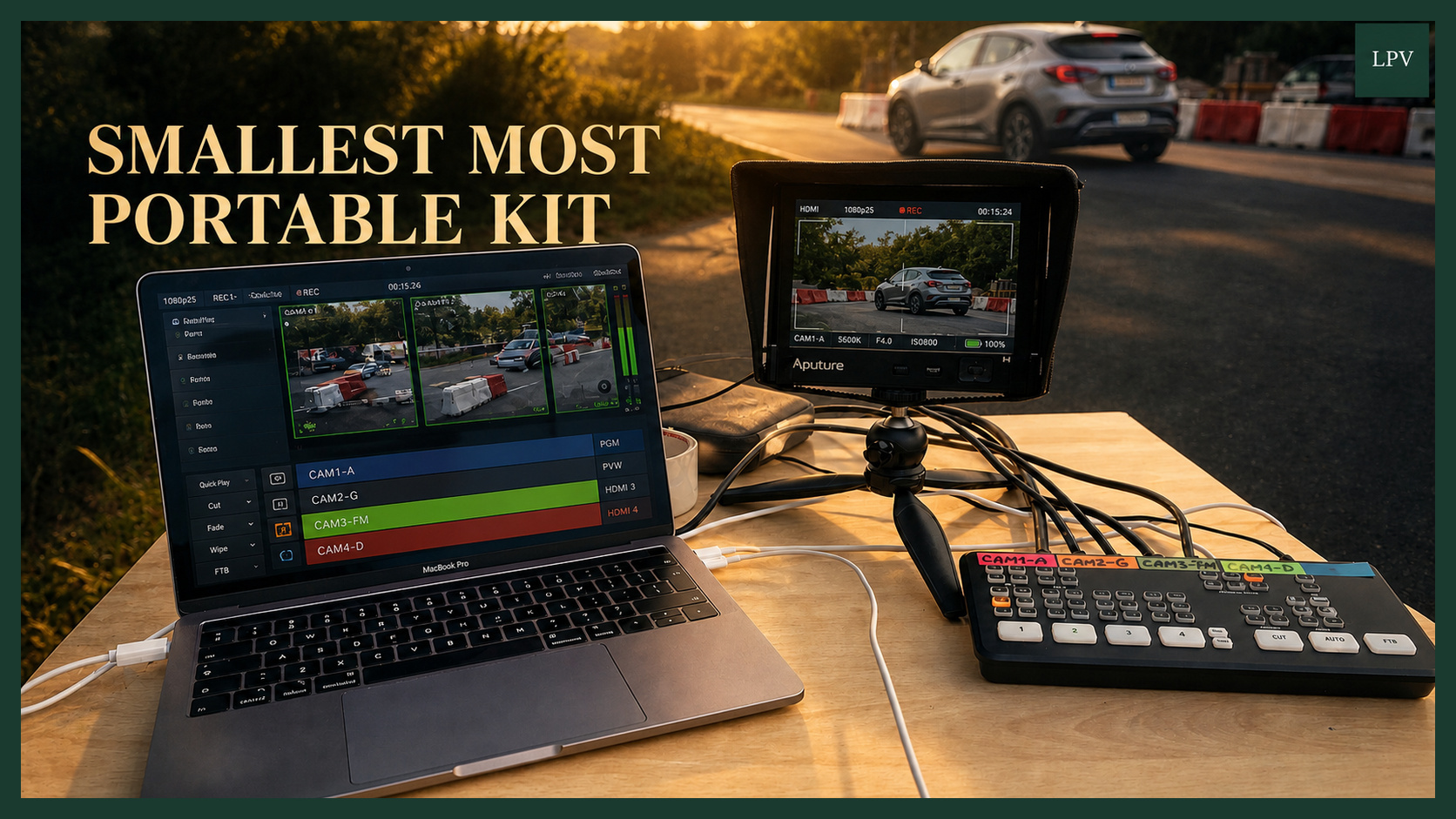
The setup is professional but deliberately improvised-looking because location work demands flexibility. Vehicles, barriers and a changing outdoor environment are reminders that the production desk has to fit where the story happens.
Alex’s core point is simple: “Sometimes you need the smallest most portable kit to make the work done.” A Blackmagic 4K eight-camera mixer has a place, but it is not automatically the right answer for every livestream.
Why Isn’t a Bigger Mixer Always Better?
A large multi-camera broadcast mixer can be excellent when the location is fixed, space is available and the production benefits from its full capability. But that value disappears if the rig slows setup, complicates travel or overwhelms a one-person operation.
The useful production check is smaller: what is the lightest setup that still gives you control of the cameras, the picture and the story? That question keeps the focus on delivery rather than equipment prestige.
For a B2B video marketing agency in London, this matters because businesses need consistent content in real working environments. The most effective setup is often the one that can arrive, operate and leave efficiently.
Who Is This For?
This approach is for UK business owners who need video content or a livestream without building a full broadcast operation on site. It is particularly useful for mobile shoots, live events, demonstrations and behind-the-scenes content where the location is tight or continually changing.
It also suits a male business owner or professional who understands marketing matters but does not want production complexity becoming another responsibility. LPV’s done for you social media London service is designed around that reality: clients provide a small amount of real video, while the wider content process is handled for them.
From Romford and Harold Wood to London-wide campaigns, portable production helps turn everyday expertise into useful, visible material. That can support authority building for professionals without demanding a studio-scale setup every time.
What Does It Cost?
The cost is not only the price of the equipment. It is also the time spent travelling with it, setting it up, troubleshooting it and needing extra people to operate it.
A compact kit can reduce those operational costs when it meets the actual brief. For automated video marketing services UK businesses should assess the outcome required, camera count, location constraints and operator capacity before choosing a production package.
What Are the Risks?
Going smaller does not mean ignoring reliability. A compact system can fail the job if it lacks enough inputs, monitoring, power planning or clear cable management.
The main risk is choosing minimal equipment for the sake of minimalism, rather than selecting the minimum kit that preserves control. Labels such as CAM1-A, CAM2-C and CAM3 reduce live-switching mistakes because they make decisions faster under pressure.
Key Takeaways
- Flexibility and adaptability are what make roadside livestream production work.
- Use a compact switcher when it can handle the required camera inputs reliably.
- Keep camera naming visible so one operator can switch confidently.
- Prioritise control of the cameras, picture and story over maximum equipment capacity.
- Professional video marketing for UK businesses should fit the real location and workflow.
Implementation Checklist
- Confirm whether the kit can travel easily to the location.
- Count the cameras and inputs required before packing.
- Label every live input clearly, including camera position or purpose.
- Check the monitor gives the operator a clear view of the active shots.
- Plan cable routes, power and a compact surface for the workstation.
- Test whether one operator can run the livestream calmly from start to finish.
Common Mistakes
- Choosing a large mixer because it looks more professional.
- Taking more equipment than the location can comfortably support.
- Leaving camera inputs unlabelled during a live multi-camera shoot.
- Forgetting that setup time and operator workload are part of the production cost.
- Building a complicated rig for content that needs to move quickly.
Make the Production Fit the Story
The roadside workstation shows that a small setup can remain in control of multiple cameras while keeping a livestream active. The goal is not to own the biggest rig; it is to make the right content reliably, wherever the work is happening.
LPV Agency helps businesses turn short, authentic recordings into consistent social content, strategy and posting. If your marketing needs a simpler system, start with the smallest workflow that can deliver the story well.
FAQ: Practical Questions People Ask
What is the fastest way to apply Portable Livestreaming for UK Businesses: Why the Right Kit Beats the Biggest Rig in a real business?
Start with one repeatable workflow, define the outcome, and automate only that part first. For example: The expensive kit is useless if it slows the job down.
This roadside multi-camera shoot runs from a MacBook Pro, Aputure monitor, compact switcher and a few well-placed cables. CAM1-A, CAM2-C and CAM3 are labelled for a reason: when the action is live, the operator needs to see each shot, make the switch and keep moving.
A Blackmagic 4K eight-camera mixer has its place.
How does this approach improve consistency and trust?
It creates a repeatable publishing cadence with clearer messaging and fewer manual delays, which improves audience confidence over time.
Do small teams need expensive tools to implement this?
No. A lightweight stack can work if it covers recording, editing, scheduling, and analytics with a clear process and ownership.
What should be measured first to validate results?
Track output consistency, content completion time, and conversion indicators (qualified leads, booked calls, or sales conversations).
Why is LPV Agency focusing on this strategy?
Because it reduces execution friction while improving visibility and lead quality. The goal is practical growth, not vanity metrics.